
Hobbs Farm before Throwback Brewery - Part 3
Hobbs Farm before Throwback – Part 3
Upon Joseph O. Hobbs’ death in 1927, son Paul, only twenty years’ old, became the owner of Hobbs Farm. Graduating in 1929 from UNH’s Agriculture Department, Hobbs put his degree to work even though he did not need to earn a living from farming.
At first Hobbs raised cows -- Ayrshire dairy cows, and shortly thereafter Brown Swiss dairy cows. First imported to the United States in the late 19th century, Brown Swiss produce rich milk that is good for cheese-making as well as drinking. They are docile and adaptable to New Hampshire’s climate. And the ones on Hobbs Farm didn’t have to climb those alpine mountains.
His choice made sense. The dairy business was a good one. North Hampton had the rail line and depot nearby so shipping milk to the Boston market was easy. There already were numerous dairy farms in town, including the large French farm on Post Road dating from the 1850s until its purchase by H.P. Hood in the early 1900s. Hobbs designed a milk room in the existing barn and began operations by 1931.
He also became active in the industry and at one time had the largest Brown Swiss dairy herd in the state of New Hampshire. No wonder Hobbs was a member of the New England Brown Swiss Breeders’ Association, and its Secretary/Treasurer in the 1940s. He also served as President of the Granite State Dairymen’s Association in 1948.
The dairy business, however, was changing by the late ‘40s post-war era. There was increased government intervention in the markets with price supports, small family farms began to vanish and large-scale, vertically integrated operations became the norm. Hobbs made plans to breed Angus cattle, known for their beef quality.
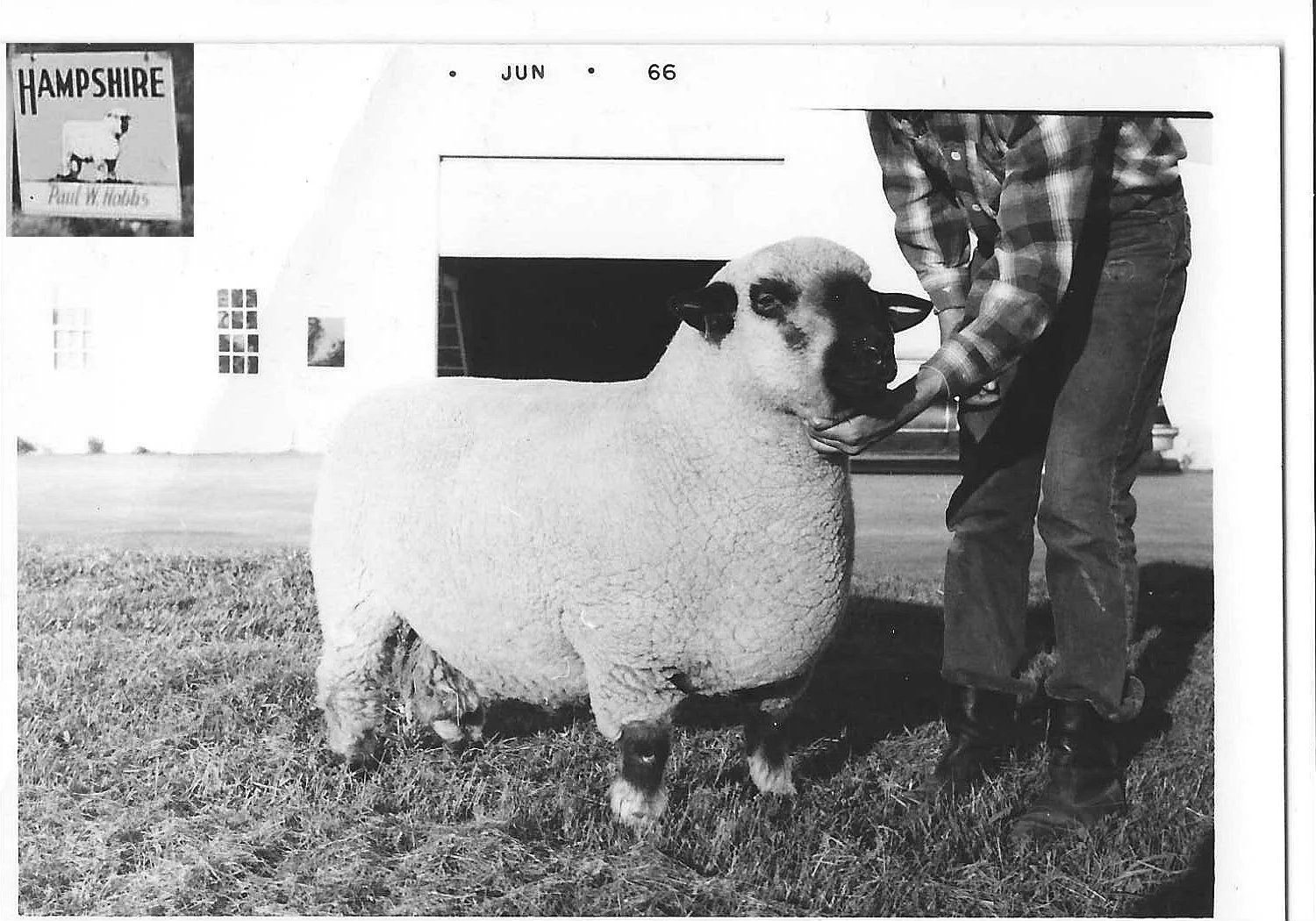
He tried Shropshire sheep in 1950 but his final choice was Hampshire sheep. The Hampshire, a large sheep, is known best for its meat although its wool can be used for knitting yarns, hosiery, felts and flannels.
Hobbs was active in the New Hampshire Sheep Breeders’ Association, NH Sheep and Wool Growers, Hampshire Sheep Association. and Massachusetts Sheep Association and more.
We also have a few ribbons attesting to Hobbs’ showing of prize-winning sheep at fairs, including New Hampshire’s largest, the Hopkinton State Fair. Those Hampshire sheep are the ones long-time residents likely remember as well as the two donkeys, Cocoa and Jericho.
What else were Hobbs and his college sweetheart, then wife Dorothy Tarr Hobbs doing all these years? Both had long resumes. Dot was a North Hampton Public Library trustee from 1936 to 1976 - forty years! The new, now old, Library housing Town Offices, got built under her watch.
Dot also was a member of the North Hampton School board (1941-1951) and managed the successful effort to build a new school that replaced the overcrowded Center School at Centennial Hall. She, Gordon Dow, and Frances Leavitt, teacher and principal of Center School, comprised the three member board. Both Leavitt and Dow served with Hobbs on the three member Library trustees board, too. Dot also made time to be President of the North Hampton Woman’s Club for its 1938/1939 year.
Meanwhile, Paul who owned and developed properties throughout town and elsewhere in New Hampshire and Massachusetts, participated in the managing of the Joseph O. Hobbs Trusts and served on the board of The Hampton Beach Improvement Company. The Trusts owned property in Boston and Somerville, MA.
Established in 1897, the Hampton Beach Improvement Company of which Joseph O. Hobbs was an investor, entered into a 99 year lease with the Town of Hampton in 1898, leasing for $500 a year a narrow strip of land between Ocean Boulevard and Ashworth Avenue, extending from Ashworth Corner to Q Street. The property abuts what is the main section of Hampton Beach. The Company laid in the cross streets where cottages and hotels were built, mostly before 1925.
Paul founded The Hobbs Insurance Agency in 1937 which he ran until 1986. The agency's main office was located in Portsmouth, first at 309 State Street and later, by 1957, at 165 Court Street in a building which he owned. There also was an office in North Hampton across from Town Hall in the Town Hall/Depot historic area of town.
In 1956 Hobbs established the Hobbs Realty Company which he operated until the mid-1990s. Among its notable real estate actions in North Hampton were the purchase of the Homestead Inn, a restaurant and later apartments, on which land the new Library now stands and the Glendale development to the north of the Library in the area between Lafayette Avenue and the rail trail.
Paul held numerous civic positions within town as well as Portsmouth and the State. In 1935 he was appointed to North Hampton’s very first Planning Board. In 1939 he became the President of the Portsmouth Rotary Club. Hobbs also served three terms as a State Representative (1941-1946) and as a member of Governor Charles Dale’s Executive Council (1946 to 1948). That’s the Dale of Dale Farm. Later, in 1951 Hobbs served on the North Hampton Zoning Board of Adjustment, as well as a Selectman from 1956 to 1961, and a Cemetery trustee.
Past generations of Hobbs reside now in Center Cemetery. The couple lived long and productive lives contributing much to the Town as did the two previous generations living on the property we now know as Throwback Brewery.
