
Hobbs Farm before Throwback Brewery – Part 2
With JWF Hobbs’ death in 1890, nephew Joseph Oliver Hobbs inherited the farm property and managed the family’s real estate and other assets in the Boston area. As he started life in Boston, might well begin this brief bio right there before getting him to North Hampton and New Hampshire.
Joseph O. Hobbs was born in Boston in 1855 to JWF Hobbs’ brother, Joseph Stacy Hobbs (1827-1907) and Mary Dearborn Andrews Hobbs. On his mother’s side, Joseph O. was related to Henry Dearborn [see my two blogs about Henry for further info about him].
Hobbs attended Boston public schools and then the Massachusetts Agricultural College, now UMass-Amherst. He began his business career working for Boston grocers Wadley, Spurr and Company located on Broad Street. He then went into the commission business with his father. Commission houses were go-betweens, acting as agents for distant producers whether in agricultural products or manufacturing.
It seems likely that when he inherited J.W.F. Hobbs estate in 1890 that J.O. Hobbs’ active role in Somerville, Massachusetts began. By the late 1890s he began constructing modern buildings in Somerville, including apartment buildings on Central Street and Highland Avenue. He remodeled a business block into the Studio Building and then in 1914 built the Hobbs Building in Davis Square, containing the Somerville Theatre. The architect was Funk and Wilcox of Boston.
Designed for that new-fangled invention, the motion picture, as well as stage shows, vaudeville, and opera, the Somerville Theatre became a landmark in the city. The rest of the Hobbs Building originally included a basement café, bowling alley, billiards hall, ten ground floor storefronts, and a ballroom holding as many as 700 persons on the second floor. Hobbs leased and then sold the building in the 1920s, but it remains in active use today.
Restored in the early 2000s, the Somerville Theatre is used for concerts, theatre, and movies. Current and future events are numerous on its website. It is one of the few theatres around that can run 70mm films, typically epic ones. Quentin Tarantino’s The Hateful Eight was one of the more recent such movies.
Joseph O. Hobbs also spent lots of time in North Hampton and New Hampshire. He was a gentlemen farmer and apple producer. [see my apple blog to learn more than you might want to know about apples]. In that era Hobbs Farm as well as John Lamprey’s Farm were the largest apple producers in town.
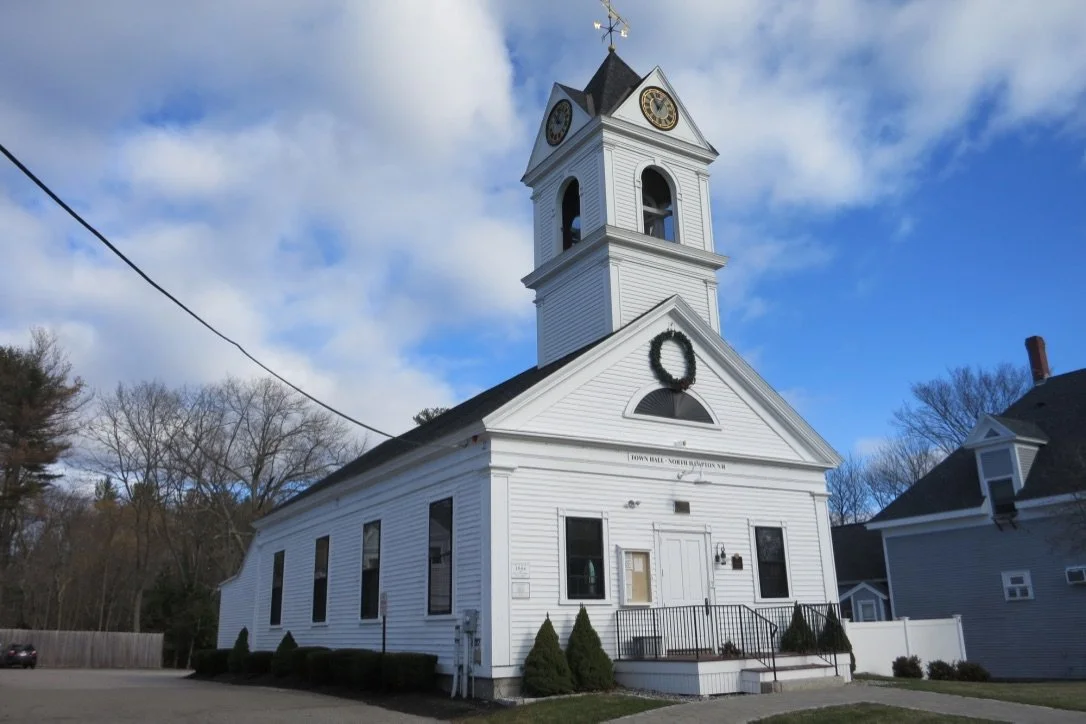
More likely, he’s remembered and described in the National Register of Historic Places for his significant addition to our Town Hall. In 1920 he donated Town Hall’s clock and clock tower that sits atop the bell tower. He also left a trust fund for maintenance of the clock. The clock is an E.H. Howard & Company one. That Boston company, founded in 1842 in Boston, was renowned for its clocks.
Its first tower clock can be seen on the Trinity Episcopal Church in Williamsport, PA (1875). A few notable buildings include the former NY Life Insurance building on Broadway in NYC, the Ferry Building in San Francisco, and the Wrigley Building in Chicago and those visiting the Village Green in Bar Harbor. Closer to home one graces the North Conway, NH Depot & Railroad Yard, now home to the North Conway Scenic Railroad. Clearly J.O. Hobbs did not think just any clock would do for North Hampton.
In addition to his business activities in Somerville and Boston, Hobbs’ civic and professional activities in New Hampshire were numerous. He was a VP of the Granite State Fire Insurance Company and Piscataqua Insurance Fire Insurance Company, both in Portsmouth, a partner in the Forest Hill Hotel in Franconia, a trustee of the still going strong Piscataqua Savings Bank, and director of another bank and a stove manufacturing company. He was a trustee of both Dartmouth and the Hampton Academy. Hobbs also served a two year term as was one of the five Executive Council members during George A. Ramsdale’s time as Governor from 1897-1899.
