
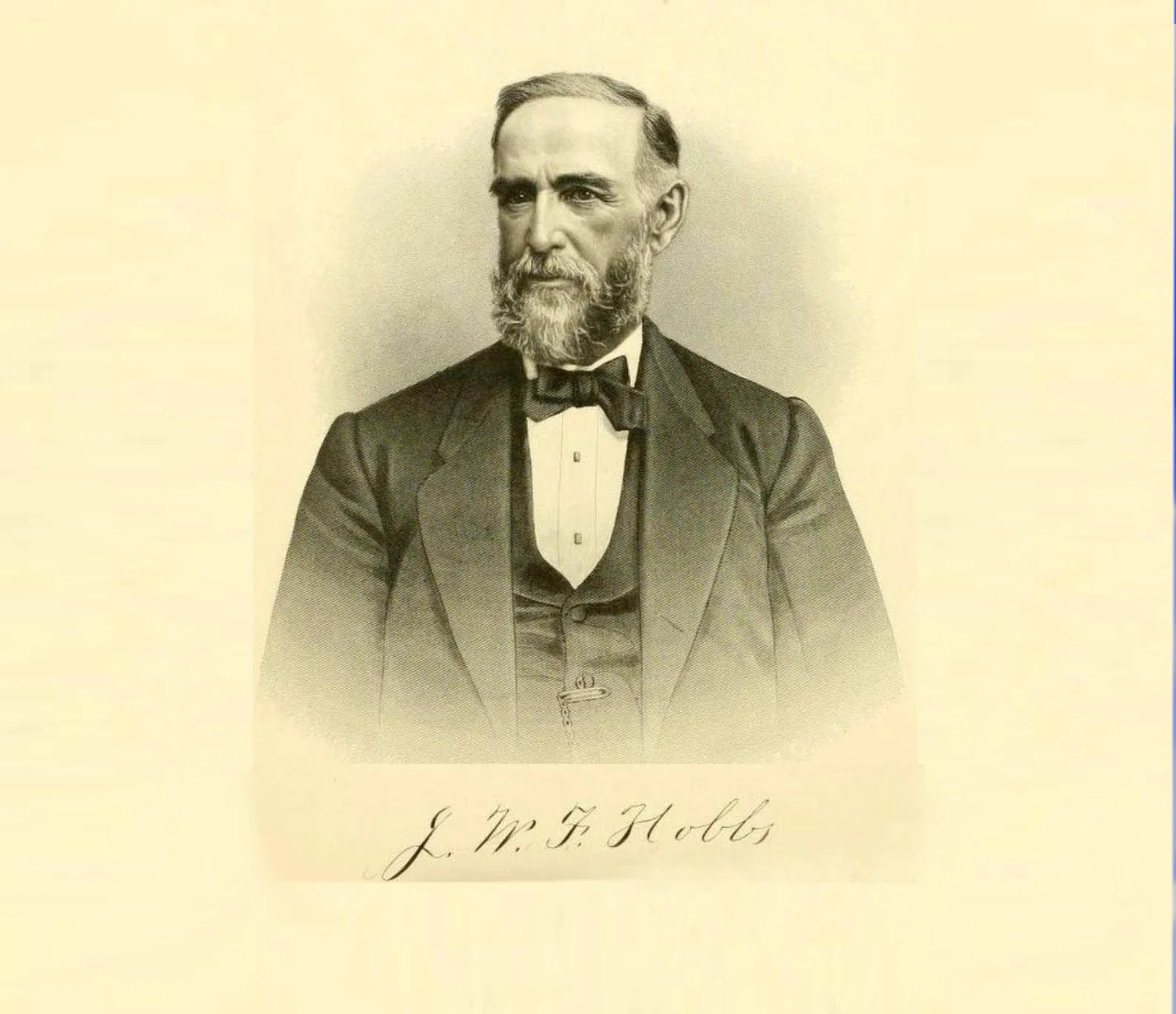
Hobbs Farm before Throwback Brewery. Part I
Those who have lived in Town a while remember Hobbs Farm and the sheep. Some of that farm is now Throwback Brewery. In the 19th century a Hobbs’ largesse built the Centennial Hall and School as well as Hobbs Farm – house and barn -- that we still see. That Hobbs was JWF Hobbs – John William Fogg Hobbs. Born in 1815 in North Hampton, he died in 1890. He had three wives, the first dying in 1856 and the second in 1865. The third, Olive A. Drake, outlived him by fifteen years, dying in 1905. But all of JWF Hobbs’ children had predeceased him and the property passed to a nephew, Joseph O. Hobbs, who died in 1927. It was Joseph’s only son, Paul W. Hobbs, an agriculture student at the University of New Hampshire at the time, who inherited the property.
The Hobbs family goes back to the earliest settlers in Hampton, some of whom moved to Hampton’s North Division, including Morris Hobbs. Most of the family were farmers in the nineteenth century. Two of the Hobbs, along with John Lamprey, had the largest farms in town.
JWF Hobbs chose a different route and set off to Boston where he made his fortune. In 1846 he started with a Mr. Prescott a horse trolley business in Boston and Somerville known as the Dock Square and Canton Street line. Dock Square is the public square in downtown Boston near Faneuil Hall and City Hall; the only Canton Street I found was East Canton in South Boston.
By 1862 Hobbs was back in North Hampton and living in the imposing French Second Empire style house constructed that year. The original building included a carriage wing with arched openings attached to a gablefront barn topped by a cupola. That’s what you still see from the road.
Besides his own home, JWF Hobbs paid for Centennial Hall and School in 1875-1876. He must have gotten tired of the controversy about replacing the Brick School at North Hill, combining the North Hill and North school districts, and building a new, larger school at North Hill. There were votes back and forth, petitions galore and frequent Town meetings, not just the once a year event we now have.
JWF Hobbs had had enough. He offered to pay for the new school himself as long as it included a social hall for the entire community. Opposition remained until what the newspaper called “raiders” in the dead of night set fire to the existing buildings. That settled that. Hobbs got the building constructed for $11,000 – around $324,000 today (seems a bargain!).
Thanks to Centennial Hall and the plans donated by Kim Nadeau we know that Boston architect John D. Towle designed what became known as Centennial Hall and Center School. We also know that Towle & Foster designed in 1852 Portsmouth’s North Church, the one you see when driving through Market Square. Considering some of the French Second Empire styles features of Hobbs’ house and Centennial Hall, perhaps Hobbs had hired the firm for his own house in 1862 and turned to Towle again, now working alone, for Centennial Hall. But, so far, no evidence has surfaced.
Centennial Hall opened in 1876, the centennial of the Declaration of Independence. That’s why it’s called Centennial Hall and celebrates its sesquicentennial in 2026 while the United States has its 250th or semiquincentennial anniversary, a quarter millennium.
