
Working on the highway
Working on the highway
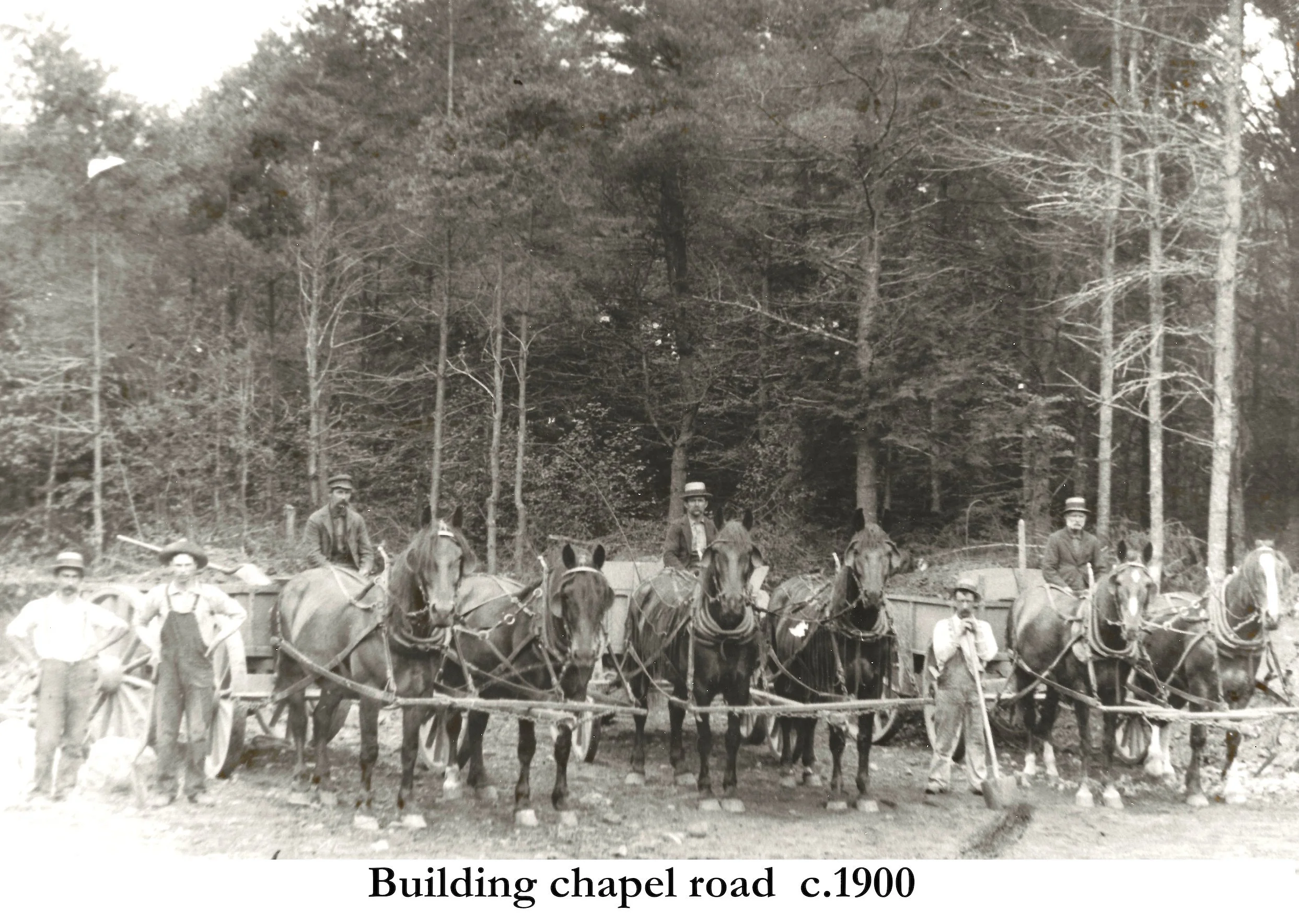
Some may remember “I’ve been working on the railroad”, a traditional song originating in England and later published in the nineteenth century in America. The Eastern Railroad came to New Hampshire and North Hampton in 1840. But much earlier, the only transportation in North Hampton would have been along dirt roads built by North Hampton men.
Their predecessors on the land were indigenous peoples who likely fished and summered here before moving inland for winter. The Abenaki also traveled along the coastline from Ipswich to Maine, making them the first fishermen on Little Boar’s Head.
European settlers would have found some of those paths, both inland and coastal, as well as animal tracks, and used them as the basis for their roads, passing by the settlers’ dwellings and farms and getting them to the coast and to the nearby and larger communities of Portsmouth, Hampton and Exeter.
The improvement and expansion of these roads was up to the inhabitants and that meant providing their own physical labor or money via a highway tax. The aftermath of mud season as well as the growth of brush and tree roots and frost-heaved rocks would have made road repair a major activity each year.
The tax could be paid by providing labor for the making, mending, or repairing of highways and bridges wide enough for wagon travel. Considering the amount of wetlands in North Hampton, it seems to me there might have been quite a few wood log bridges that might have needed work, too.
The person(s) named Surveyor of Highways would receive the warrant indicating the sum owed by each person, based upon land holdings, and have them work until that sum was reached. If the person did not appear to do the work, the Surveyor had the power to collect the sum of money owed by seizing goods.
The number of days of labor necessary would vary depending upon the estimated amount of work a road required in a given year. That amount would be estimated and agreed upon at a town meeting.
The Historical Society has one such small booklet dating from 1867. It provides information about who lived in a particular area of town that year. Not all the districts seem to be listed, and the district numbers do not run consecutively. Perhaps there was more than one highway surveyor for the Town that year?
There also is another such booklet in the Town Clerk’s collection dating from 1884. These districts have numbers, not descriptive names and, like the earlier one, the names of the property owners within a given geographic area.
There were resident and non-resident property owners just as today. They all had to pay up, one way or the other. As for dirt roads, I believe it was not until the 1920s that any road in North Hampton was paved. Atlantic Avenue and Lafayette Road, the latter designated as part of the new U.S. Route 1 system in 1926, may have been the first macadam roads in town.
And, for anyone wondering, there were no numbers on North Hampton houses until the mid to late 1950s. Post-World War II growth and evolving postal regulations prompted the change with subsequent modifications made to improve emergency response and the 911 system in the past few decades.
Anyone with additional information, please contact us.
************
And now for a brief commercial announcement. If you enjoy the blogs, the Facebook entries, and the many photos added and now available on our revamped website, we hope you will encourage us by supporting the North Hampton Historical Society -- volunteering to work on the collections, plan programs, or by contributing money in the form of annual dues or one-time donation.
